


 English
 Español
 中文简体
Product Consultation
Your email address will not be published. Required fields are marked *
Cold Heading Agricultural Machinery Parts: A Foundation for Durability
Aug 06,2025What should you know about synchronizer guide block assembly?
Aug 06,2025Why Bus Gearbox Parts Are Critical for Vehicle Performance?
Aug 06,2025Commercial Vehicle Gearbox Parts: A Comprehensive Guide to Market Trends and Maintenance
Aug 06,2025Every shift in a dual-clutch transmission starts with one small steel block: the DCT synchronizer slider. When that block loses surface hardness, flatness, or dimensional control, the first symptom is usually a hesitant or gritty gear engagement somewhere around 60,000 to 90,000 km, and the worst case ends with a complete gearbox teardown. For engineers and purchasing teams sourcing these parts, the practical question is not just where to buy, but how to confirm that a slider will survive the duty cycle of a modern DCT.
A DCT synchronizer slider is the spring-loaded block inside a synchronizer hub that pushes the synchronizer ring onto the gear friction cone as the shift sleeve moves. It performs the mechanical speed-matching work before the dog teeth can lock. Without it, a dual-clutch transmission cannot complete a clutch-to-clutch shift without grinding.
The sequence is the same in principle as in a manual gearbox, but faster and far more frequent. When the shift fork moves the sleeve toward the target gear, the slider flank rides against the sleeve's inner chamfer and forces the synchronizer ring into contact with the gear cone. Friction equalizes the shaft speeds within 50 to 150 ms. Once the speed difference falls below the dog-teeth threshold, the sleeve passes over the slider and locks onto the gear. Three sliders, normally spaced 120 degrees apart in each hub, keep the ring force even around the cone.
Four jobs ride on that small block:
DCT synchronizer sliders are cycled more often, under higher loads, and inside a tighter shift window than sliders in manual transmissions, so a part that performs well in an MT can fail early in a DCT.
The biggest difference is pre-selection. A DCT engages the next gear while the current gear still carries torque, so the slider is pressed against the synchronizer ring earlier and held longer during every shift. With faster actuation, the flank contact pressure is higher as well. That combination moves case hardness, case depth, and flank geometry to the top of the slider design priority list.
Carburized low-alloy steel is the default material for DCT synchronizer sliders because it gives the surface hardness that wear resistance demands while retaining a tough core for impact loads. 16MnCr5 and 20MnCr5 are the most common grades. Carbonitrided steel and sintered powder metal appear when cost or part integration is the priority.
| Material route | Surface hardness | Case depth | Cost index | Typical duty |
| Carburized 16MnCr5 | 58-62 HRC | 0.3-0.6 mm | 1.0 | DCT and MT sliders |
| Carbonitrided steel | 56-60 HRC | 0.2-0.4 mm | 0.85 | Light-duty shift parts |
| Sintered powder metal | 40-50 HRC | Through-hardened | 0.6 | Cost-sensitive programs |
| Induction-hardened steel | 50-55 HRC | 1-3 mm pattern | 0.9 | Large or low-volume parts |
The manufacturing route matters as much as the chemistry. Cold heading, the process OnRoll uses for its slider family, forms the block by upsetting wire at high speed, so the grain flow follows the contour of the part instead of being cut through. In impact-loaded synchronizer applications, cold-headed sliders consistently outlast machined sliders with identical chemistry. For volumes above 50,000 pieces per year, cold heading also reduces material waste and unit cost. Machining still has a place for complex undercuts and prototype batches, but it is a second choice for high-volume DCT sliders.
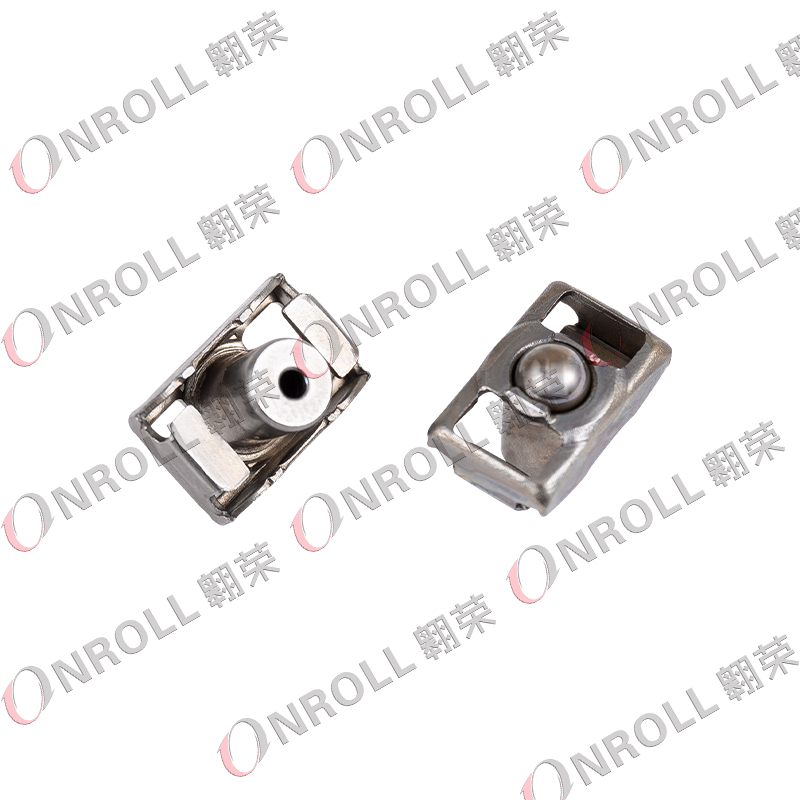 OnRoll Cold-Headed DCT Synchronizer Slider AssemblyThis slider is formed by stamping in a step-in die, giving stable dimensions and spring elasticity. It suits high-volume DCT production and is highlighted here because cold heading improves grain flow and durability over machined parts.View Product →
Typical surface hardness values for slider material routes in DCT synchronizers.
Hardness alone does not tell the full story. The chart compares typical surface hardness values, but effective case depth, the hardness profile below the surface, and core toughness decide how long the flank keeps its shape under repeated impact. A shallow case that measures fine on the surface can still spall after 100,000 shifts.
Four measurements separate a DCT-ready slider from a reject: surface hardness, effective case depth, flank profile, and detent-groove condition. If a supplier cannot document all four with SPC data, the part is not ready for series production.
These numbers are not arbitrary. The flank is the face that presses the synchronizer ring, so its hardness and finish set the wear rate. The detent groove controls the sleeve position and the shift feel. Both surfaces need enough case depth to avoid case crushing under detent spring load.
Five checks to run before approving a DCT synchronizer slider supplier:
OnRoll's passenger-car catalog includes application-specific sliders such as the 5th-reverse unit and the LC5T80B range, each released with batch-level records for dimensions, hardness, and material traceability. For a complete breakdown of slider and strut types, including their function in manual and automated gearboxes, read OnRoll's synchronizer strut explainer.
 OnRoll 5th Reverse Synchronizer Slider for Lightweight TransmissionsA stamped, hollow slider reduces product weight while maintaining strength, addressing lightweight needs in passenger and commercial vehicle synchronizers. It appears after a discussion of application-specific sliders, showing a concrete example from the catalog.View Product →
Thrust-face wear, detent-groove spalling, and edge chipping cause most DCT slider failures, and all three trace back to decisions on hardness, case depth, and edge geometry made before the part entered production.
| Failure mode | Root cause | Preventive action |
| Thrust-face wear | Surface hardness below 56 HRC or case depth below 0.3 mm | Specify 58 HRC minimum and verify case depth on the flank |
| Detent-groove spalling | Case crushing from pointed detent springs under high load | Widen the contact area and increase case depth above 0.4 mm |
| Edge chipping | Sharp edges combined with a brittle hardened case | Add an edge break of 0.2-0.4 mm on all contact contours |
| Dimensional drift | Uncontrolled tool wear during cold heading or machining | SPC monitoring with Cpk above 1.33 on flank angle and groove width |
None of these failure modes is acceptable in a DCT because a worn slider sheds particles into the oil circuit, which then damages the clutch pack and hydraulic valves. Replacement sliders must match the original flank geometry exactly. For the repair segment, OnRoll produces the LC5T80B 3-4-R-5 gear slider with dimensions verified against the original equipment drawing, so a rebuild does not have to compromise shift quality.
 OnRoll LC5T80B 3/4 R/5 Gear Slider for Repair and RebuildThis cold-drawn slider is dimensionally verified against the original equipment drawing, making it suitable for repairs where replacement parts must match factory geometry. It is relevant here because the preceding text emphasizes the importance of exact flank geometry in DCT rebuilds.View Product →
Jiaxing OnRoll Machinery Co., Ltd. has produced synchronizer sliders continuously since 1992, and each product generation tracked a structural shift in the Chinese transmission market.
The company runs a 4,000 m2 plant with automatic dimension and elasticity inspection, and it holds IATF 16949 quality certification plus ISO 14001 and ISO 45001 registrations. For customers that need drawing-based nonstandard parts, OnRoll operates a dedicated OEM factory with cold heading and custom machining lines.
The two clutches only connect the engine to the two input shafts. Inside the gearbox, every target gear still has to be synchronized to its shaft speed before the dog teeth can lock, and that speed-matching step is performed by the synchronizer ring plus the sliders that push it.
A carburized slider with correct geometry and heat treatment lasts the life of the synchronizer assembly. Premature failures at 80,000 to 120,000 km are almost always caused by insufficient case depth, low surface hardness, or a mismatch between detent spring force and flank angle.
Yes, provided the hub, sleeve, ring, and gear cone are still within specification. Measure the ring-to-cone clearance and inspect the sleeve dog teeth before deciding. Replacing only the sliders is a proven repair strategy in DCT remanufacturing.
At high production volumes, cold heading is better on both reliability and cost because the grain flow follows the part contour and material waste is minimal. Machining is justified for unusual geometries, prototype batches, or output below roughly 50,000 pieces per year.
Your email address will not be published. Required fields are marked *

(+86)-191 0581 0729
(+86)-137 5830 1558