


 English
  Español
  中文简体
中文简体
Product Consultation
Your email address will not be published. Required fields are marked *
Cold Heading Agricultural Machinery Parts: A Foundation for Durability
Aug 06,2025What should you know about synchronizer guide block assembly?
Aug 06,2025Why Bus Gearbox Parts Are Critical for Vehicle Performance?
Aug 06,2025Commercial Vehicle Gearbox Parts: A Comprehensive Guide to Market Trends and Maintenance
Aug 06,2025A gearbox that begins grinding on the 3-4 shift at 80,000 km is rarely a driving-style problem. The root cause normally sits inside the hub: a synchronizer slider that has lost its strut spring tension, a guide block worn past its dimensional limit, or a detent pin that can no longer hold the shift rail in position. Transmission shifting components are the precision parts that convert lever motion into clean, synchronized gear engagement, and their wear behavior decides whether a gearbox shifts smoothly for 300,000 km or comes back for warranty rework before 60,000.
Sourcing teams that understand these parts make fewer field returns and negotiate from a position of verified data. This guide covers the complete shift path, the dominant failure modes from a 500-unit field study, the cold-heading versus machining trade-off, and the quality checks that separate a dependable components supplier from a marginal one.
The gear engagement path in a manual or automated manual transmission runs from the lever, through the cable or rod and shift fork, into the synchronizer assembly, and finally to the gear hub, and every component in that chain must hold micron-level geometry under repeated axial load.
When the driver moves the lever, the shift rail slides a fork that presses the synchronizer sleeve, commonly called the slider, toward the target gear. The slider is splined to the gear hub and carries spring-loaded struts in its internal grooves. Those struts push the synchronizer ring against the gear cone; friction equalizes input and output speeds; then the slider spline teeth slide over the ring gear teeth and lock the gear to the hub. A guide block or stop block absorbs the final impact at the end of travel, while a detent pin and interlock plate hold the rail in position and prevent two gears from engaging at once.
Each component contributes to shift feel in a measurable way. The list below summarizes the function and the failure-critical surface of each one.
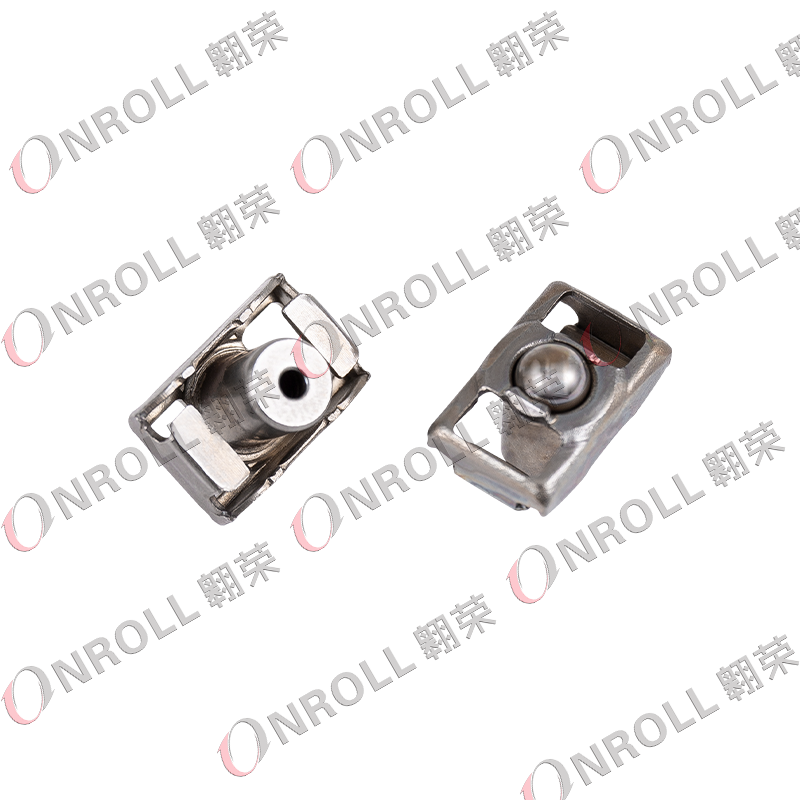 Case-Hardened Passenger-Car Synchronizer Slider AssemblyThis stamped slider is carburized to a controlled case depth for stable groove dimensions and shift feel. Its lightweight, high-integration design suits manual and automatic transmissions, making it a key component when evaluating shift smoothness.View Product →
A passenger-car synchronizer slider made from case-hardening steel and carburized to a 0.3-0.8 mm effective case depth, with the strut-groove width held to +/-0.02 mm, represents the current performance baseline for high-volume manual gearboxes.
Four failure modes account for more than 90 percent of field returns in shifting components: slider strut-groove wear, detent-pin fatigue, guide-block fracture, and baulk-ring face wear, and each leaves a different diagnosable signature on shift feel.
In a field-return study of 500 synchronizer assemblies completed by our engineering team between 2024 and 2025, the primary failure distribution was:
Primary failure mode, field-return study of 500 synchronizer assemblies
Slider strut-groove wear appears first as grinding on the 2-3 upshift; the usual cause is a case depth too shallow for the contact pressure, so the groove edge yields and rounds off. Detent-pin fatigue produces notchiness and occasional gear pop-out, because over-hardened pins become brittle and crack at the undercut. Guide-block fractures show as a loose shift feel with incomplete engagement, and they originate at sharp internal radii that concentrate impact stress. Baulk-ring face wear forces double-clutching, since friction can no longer equalize speeds fast enough.
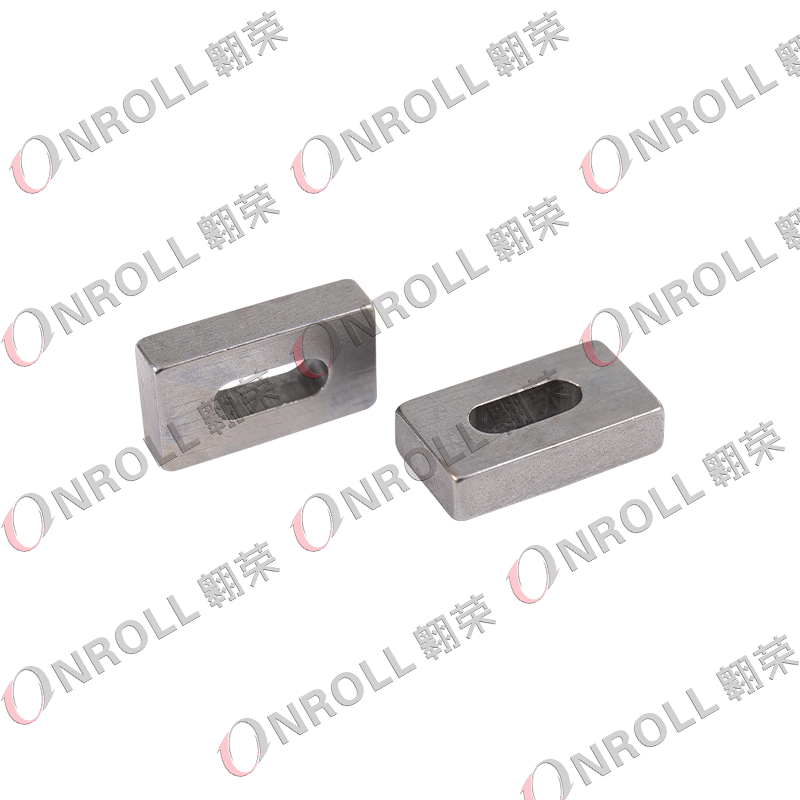 Cold-Headed Synchronizer Stop Block for Impact LifeFormed by cold heading, this stop block avoids stress raisers from machining and improves impact resistance. It limits slider release during use, addressing the guide-block fractures that cause loose shift feel and incomplete engagement.View Product →
The stop block is the most impact-loaded component in the synchronizer package. Switching from a machined to a cold-headed stop block eliminates the stress raisers created by cutting marks and improves impact life by changing the grain flow around the transition radius.
The manufacturing process fixes the cost, tolerance, and fatigue life of a shifting component before the first part ships, and cold heading is the dominant route for high-volume sliders, pins, and push blocks because it preserves grain flow and keeps unit cost low.
Process selection depends on geometry, volume, and the stress spectrum of the application. The table below compares the three routes that matter most for transmission shifting components.
| Process | Typical tolerance | Economic batch size | Relative piece cost | Typical shifting parts |
| Cold heading | +/-0.02 mm | 50,000 and up | Lowest | Sliders, detent pins, push blocks |
| CNC machining | +/-0.005 mm | 1,000 to 20,000 | Medium to high | Guide blocks, shift forks, brackets |
| Powder sintering | +/-0.05 mm | 100,000 and up | Low | Low-load guides, spacers |
Grain flow follows the part contour, which improves impact fatigue strength. Material utilization is near 100 percent, scrap is minimal, and the formed surface needs little or no machining. For a detent pin or slider with a 0.3-0.8 mm carburized case, cold heading delivers the lowest cost per piece.
Complex undercuts, deep cross-holes, or extremely tight sub-millimeter tolerances that cannot be held in the die are better machined. Low-volume service parts and prototype runs also favor machining because there is no tooling amortization to recover.
Material choice sits on top of the process decision. Case-hardening steels 20CrMnTi and 16MnCr5 dominate sliders and push blocks; stainless grades such as 420 or 430 appear where corrosion resistance matters, for example in detent pins exposed to humidity; engineering plastics such as POM and PA66 work in low-load guide blocks where weight and friction matter more than impact strength.
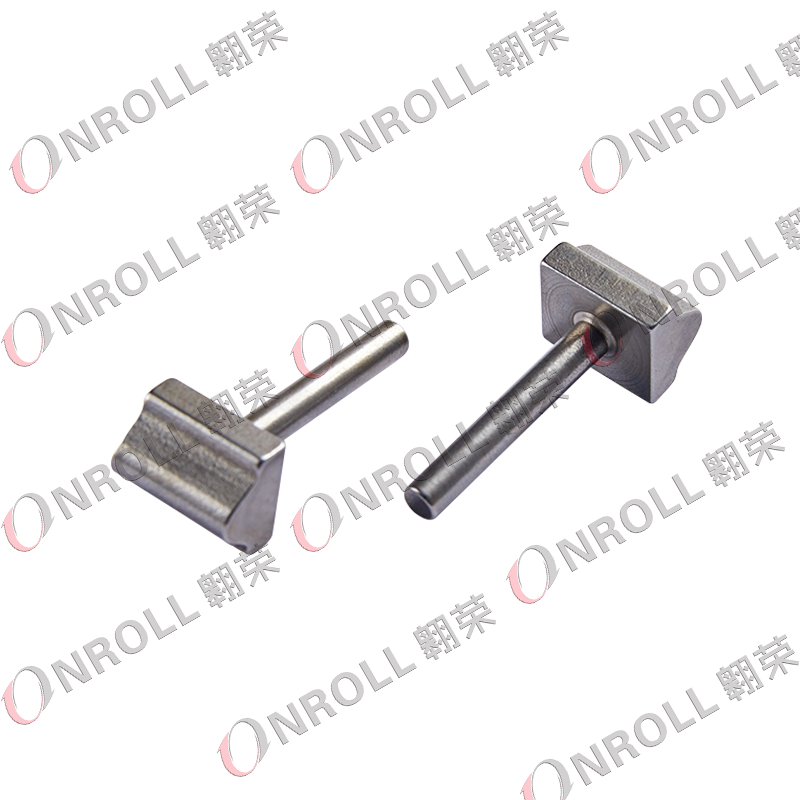 Commercial-Vehicle Push Block with Cold-Heading and MachiningCombining cold heading with machining, this push block retains mechanical strength while lowering cost. Designed for heavy loads and torques in commercial gearboxes, it suits high-stress applications where deformation resistance is required.View Product →
A cold-headed commercial-vehicle push block produced from 20CrMnTi, carburized to a 0.4-0.6 mm case depth, typically carries shift loads of 3,000-5,000 N in heavy-duty truck gearboxes without measurable deformation over the design life.
A shifting-component supplier must prove four things with documents and samples: dimensional capability, heat-treatment control, material traceability, and process stability, and IATF 16949 registration is the entry ticket, not the verdict.
Use the following five checks as a minimum acceptance routine before a new part moves into series supply.
A synchronizer slider's strut-groove width is the single most audited dimension in incoming inspection. When it exceeds the print limit by 0.05 mm, the strut loses its radial preload and the synchronizer ring no longer contacts the gear cone early enough, so the driver feels a hard, notchy shift.
The slider is the splined sleeve that physically locks the gear to the hub after speed synchronization. The ring is the friction element that uses cone contact to equalize input and output speeds before the slider teeth engage. A damaged ring causes grinding; a damaged slider causes incomplete locking, gear pop-out, or both.
Shop practice treats a strut-groove width that has grown by 0.05 mm beyond the print limit, or visible rounding of the spline chamfer over more than 20 percent of its length, as the replacement threshold. At that point the synchronizer assembly no longer holds the speed-matching window and shift quality degrades quickly.
Yes, but only in the right load envelope. POM and PA66 guide blocks perform well in low-load shift paths where engagement forces stay below roughly 1,000 N. In heavy-truck or high-torque applications, a steel cold-headed block is required; substituting plastic in those positions produces cracks and incomplete engagement in less than 50,000 km.
A single measurement proves the sample, not the process. Cpk of 1.33 or higher means the process spread stays within the tolerance band with margin, so future batches will behave like the approved one. Without a stable Cpk, you can pass the first article and then receive intermittent out-of-tolerance parts from the same die.
Your email address will not be published. Required fields are marked *

(+86)-191 0581 0729
(+86)-137 5830 1558